Industrial automation is a decisive success factor for efficiency, quality and competitiveness in modern manufacturing. It enables companies to optimize production processes, reduce costs and ensure consistently high product quality at the same time. Automation is no longer only an issue for the automotive industry, but is relevant across many sectors: from food and beverage production to the chemical and pharmaceutical industries and special-purpose machinery.

We support you from planning to the completion of your automation project.
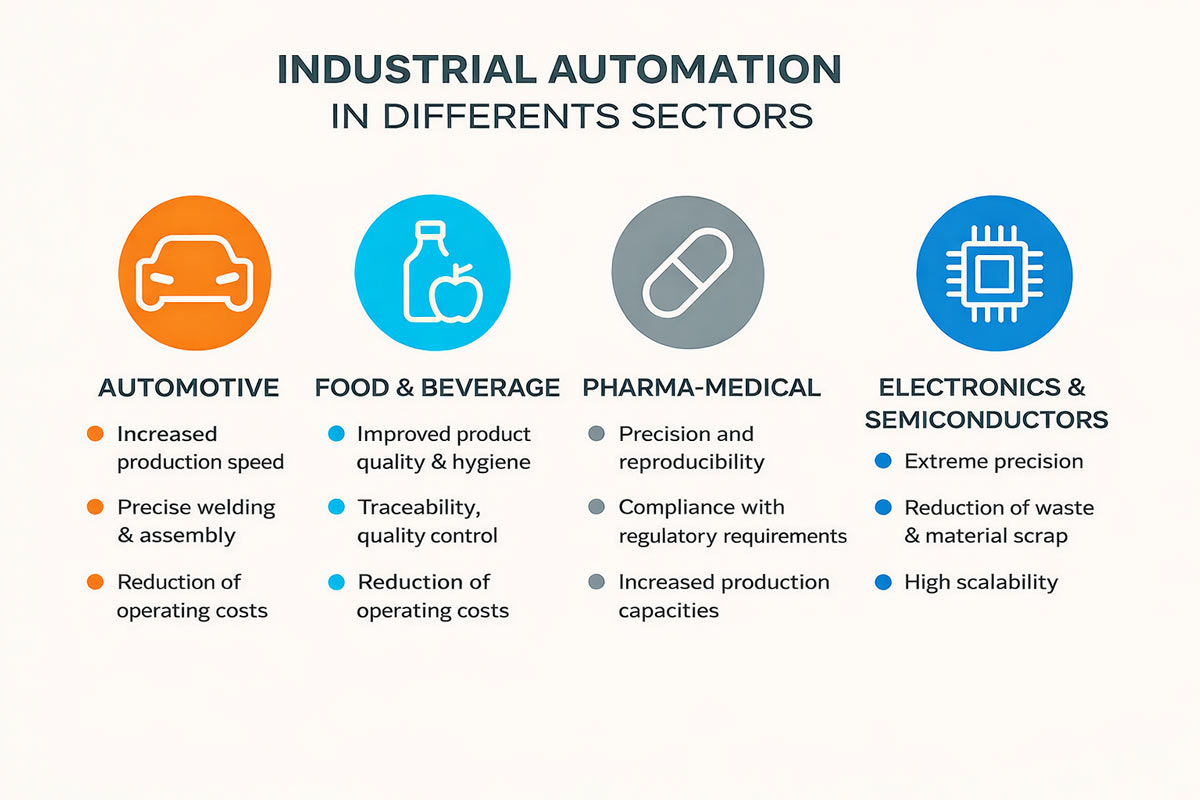
Industrial automation increases efficiency, reduces sources of error, lowers long-term operating costs and ensures consistently high product quality. In addition to large manufacturing companies, small and medium-sized businesses also benefit through targeted partial automation and offsetting skilled labor shortages.
The infographic shows four key sectors in which automation technologies can bring particularly strong benefits, each with three specific examples per sector.
We would be happy to present in a personal meeting just how diverse and valuable the targeted use of modern automation solutions can be for your company.
Contact an expert nowOur solutions are not off-the-shelf products, but are developed individually to make your specific production processes more efficient, flexible and robust. These include:
Our PLC solutions are individually developed to make your specific production processes more efficient, flexible and robust. These include:
Our control systems enable powerful and seamless networking between machines, systems and higher-level control systems. Modern technologies are used, including:
Modern visualization systems give you a precise real-time overview of your production processes. We develop user-friendly HMI and SCADA interfaces including:
We support you through all phases of your automation project – from concept development and planning to programming, successful implementation and employee training:
For reliable and future-proof automation, we rely on common industrial standards and proven technologies, including:
Future-proof standards ensure seamless integration and maximum efficiency in your production.
Industrial automation refers to the use of technologies such as sensors, control systems and robotics to enable production and manufacturing processes to run efficiently, safely and reproducibly without manual intervention.
It increases productivity, reduces sources of error, lowers long-term operating costs and enables consistently high quality in production, while improving resource utilization at the same time.
In addition to the automotive industry, sectors such as food and beverage, pharmaceuticals and medical technology, electronics and semiconductors, and plastics production all benefit from automated processes.
Yes, SMEs can also increase their efficiency, compensate for skills shortages and secure competitive advantages through targeted partial automation, often with manageable investment costs.
Typical technologies include PLC controls, robotic systems, machine vision, IoT components, AI-based analytics, and SCADA and MES systems for central monitoring and control.
A good starting point is an analysis of the existing processes. This is followed by a feasibility study, the selection of suitable technology, and step-by-step implementation including training.
Challenges often include initial investment costs, integration into existing systems, a shortage of skilled workers and process change. With good planning, however, these can be minimized.
Would you like to make production processes even more efficient and integrate industrial robots specifically into your systems?
Our experts develop tailor-made robotics solutions – from programming to full integration into existing systems.
Discover our service portfolio in robotics now.